Data lives in different places
Customer details, project updates, documents and financial data are split across spreadsheets and disconnected tools.
One platform built around the way your company works. Connect CRM, operations, employees, finance, documents, reporting, integrations and AI—without forcing the business into another generic tool.
More customers, employees and services often mean more spreadsheets, more subscriptions and more manual coordination. A custom Business OS gives the company a dependable operational foundation.
Customer details, project updates, documents and financial data are split across spreadsheets and disconnected tools.
Employees copy information, chase approvals and rebuild the same reports instead of moving the operation forward.
There is no reliable real-time view of workload, delivery, cash flow, margins or accountability.
Not development hours. Not another off-the-shelf subscription. OPSYNQ delivers a business management platform that becomes part of how your company operates and improves.
Customers, operations, employees, finance and documents work from the same structured data.
Roles, permissions, stages and business rules reflect how your company actually operates.
Approvals, tasks, notifications, documents and handoffs move automatically.
Google, Meta, Microsoft, accounting systems, existing databases and documented APIs can stay connected.
Your operating platform becomes a long-term business asset without generic SaaS limitations.
Start with the operational bottleneck, then add teams, workflows, companies and industry modules.
Build the modules that matter now and expand when the next bottleneck appears. Every part shares the same data, permissions and business logic.
Leads, customers, pipelines, communication and commercial activity in one tailored workspace.
Projects, tasks, responsibilities, deadlines, approvals and delivery workflows connected end to end.
Invoices, costs, margins, forecasts and management dashboards built around the decisions you make.
Generate, route, sign, store and retrieve business documents without manual duplication.
Custom ERP, purchasing, warehouse, inventory, production and logistics modules where required.
AI assistants and agents that classify, prepare, summarise and act inside controlled business workflows.
OPSYNQ can become a vertical construction CRM for material suppliers—not just a place to store contacts, but the complete sales and project workflow from first response to quotation, invoice and delivery.
Illustrative demo workspace · No real customer dataNew enquiries enter the CRM with campaign source, contact details and arrival time ready for manager follow-up.
Area, problem, materials, services, photos, answers and site requirements become one structured object record.
Calculate material consumption, reserve, margin and delivery before generating a controlled commercial offer.
Track first contact, response speed, fresh comments, daily tasks and deals that need immediate attention.
Connect the customer, project, contractor, quotation, invoice, files and delivery activity in one history.
See leads, response time, quotations, payments, win rate and reasons for lost deals by manager and source.
One visible sales process for managers, technical teams and leadership.
These are real screens from the OPSYNQ product experience—not a stock dashboard or a design concept. Each workspace turns operational data into a clear next decision.
Actual interface · Demo data shown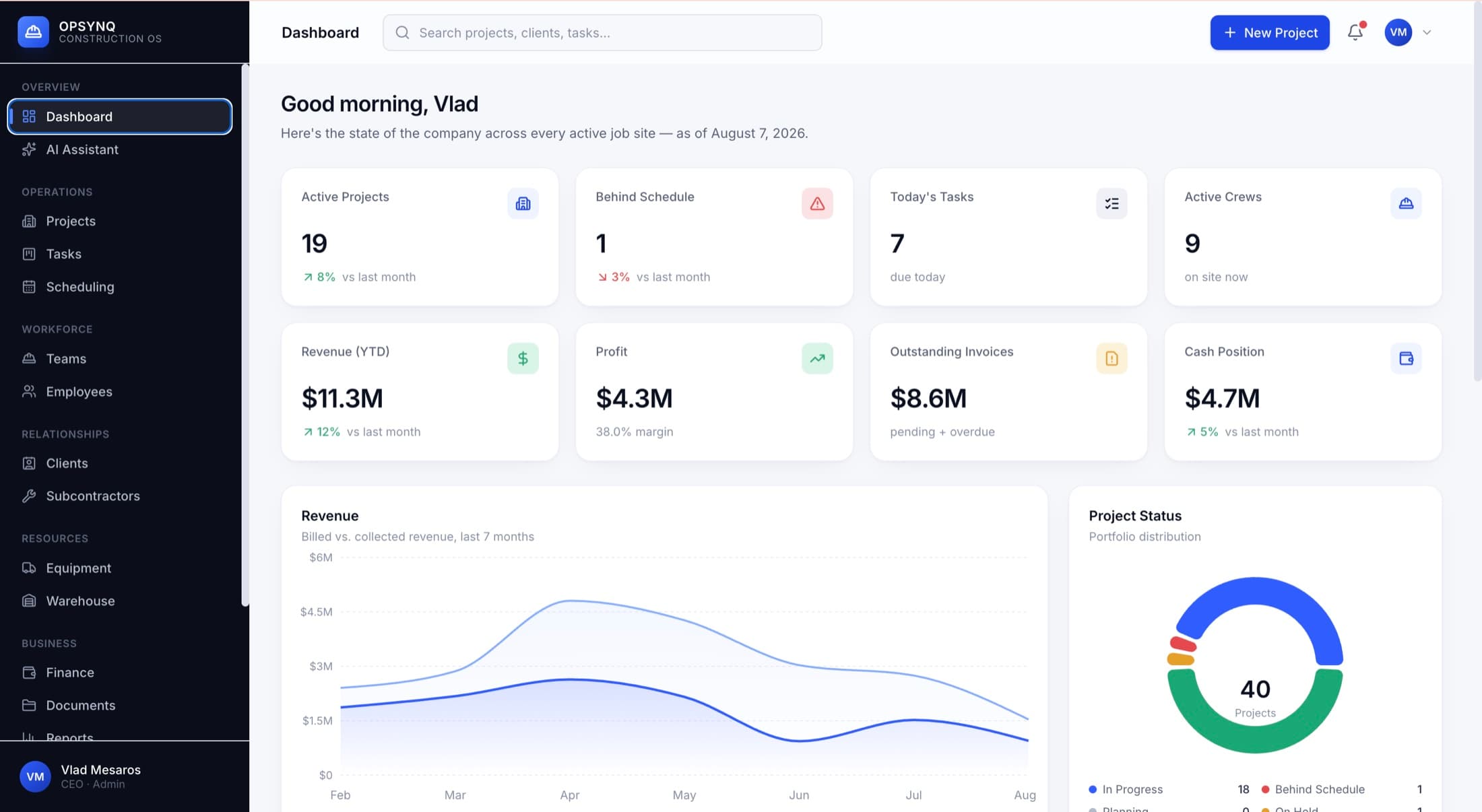
Projects, delays, tasks, crews, revenue, profit, outstanding invoices and cash position—visible without waiting for manual reporting.
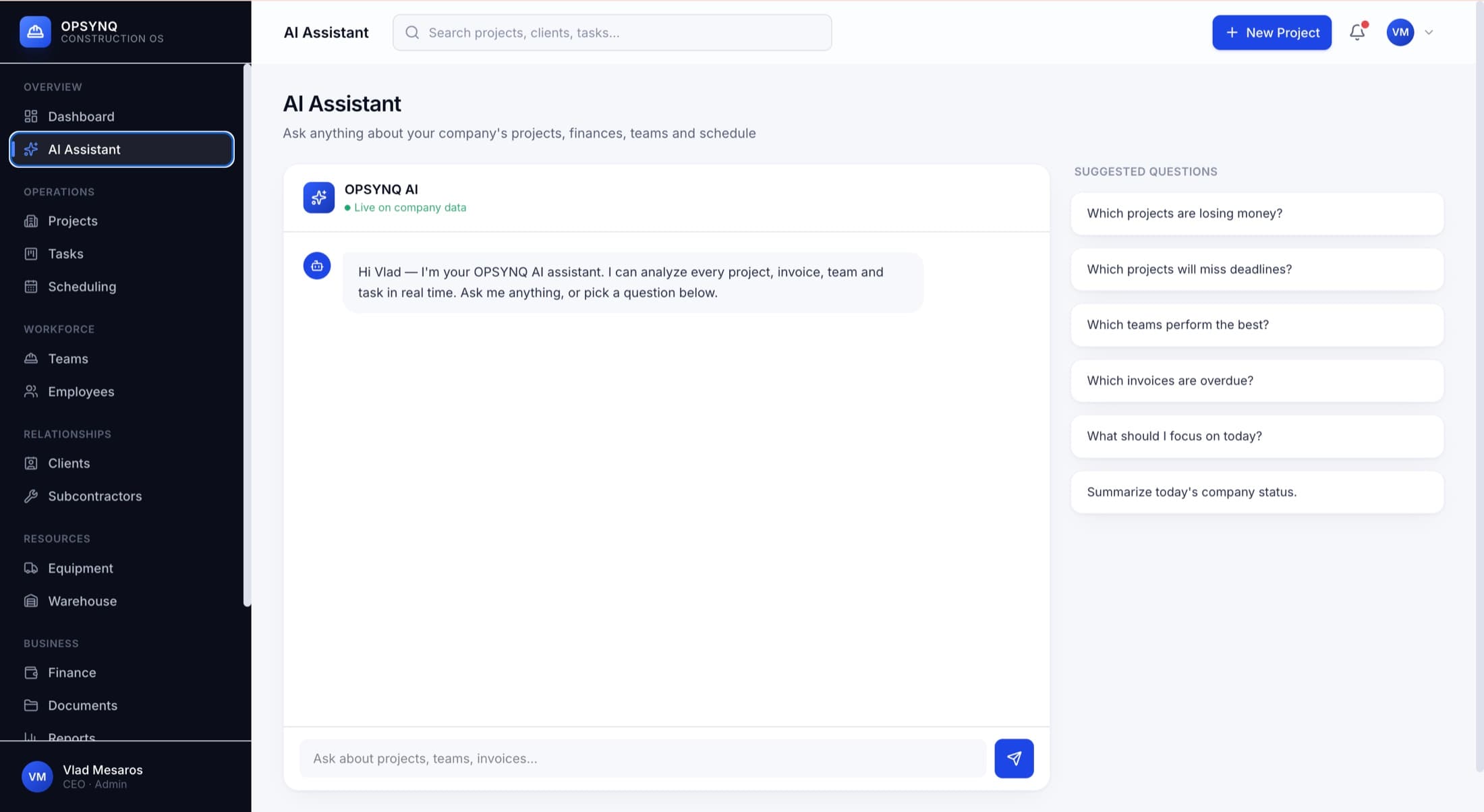
Analyse projects, invoices, teams and schedules through a controlled assistant connected to company data.
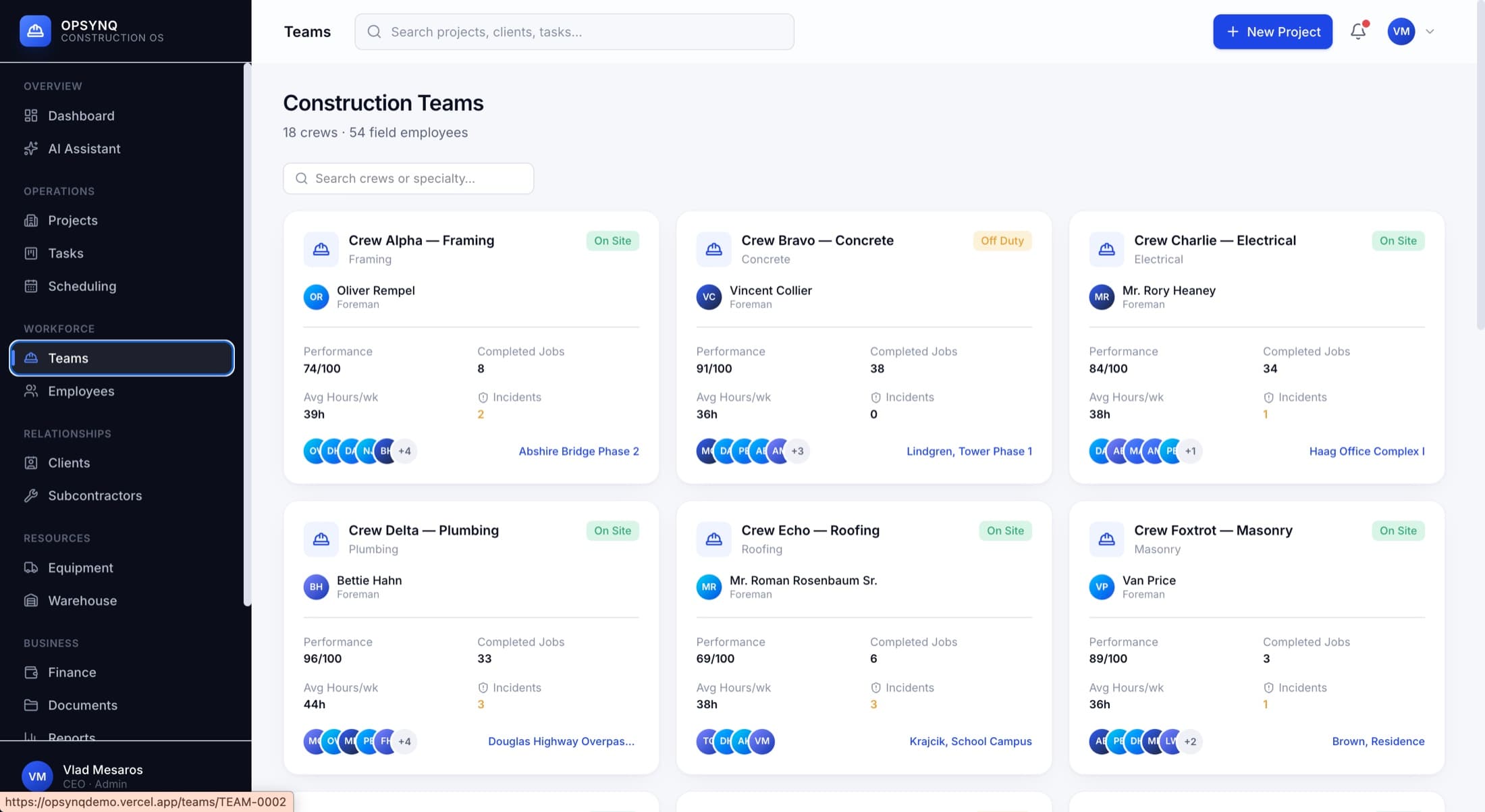
Track availability, foremen, performance, hours, incidents and the active project for every construction team.
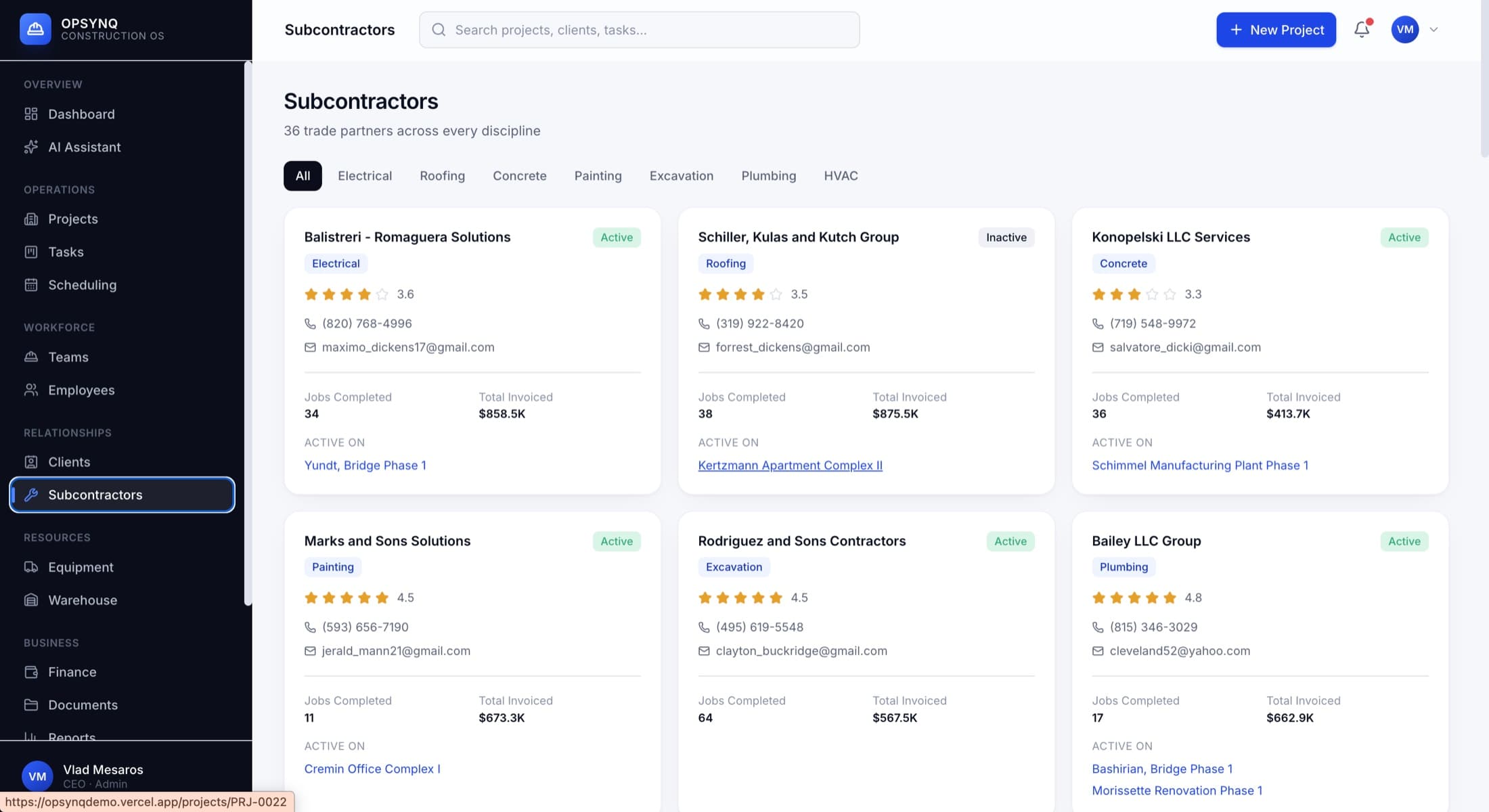
Manage specialties, ratings, contacts, completed work, invoiced value and current project assignments.
A lead from Google or Meta can become a customer, project, task plan, document set, invoice and management report—without rebuilding the same information across departments.
The same Business OS foundation is configured around each company’s terminology, roles, compliance needs and competitive workflows.
Explore all industry solutions ↗Leads, estimates, sites, crews, subcontractors, costs and variations.
Orders, production, materials, quality, capacity and operational reporting.
Customers, pricing, stock, purchasing, fulfilment and margin control.
Orders, dispatch, fleet workflows, documents, costs and delivery visibility.
Properties, tenants, maintenance, documents, payments and portfolio reporting.
Sales, client onboarding, delivery, utilisation, billing and account visibility.
Custom construction management software connecting leads, estimates, projects, sites, crews, subcontractors, documents, costs, variations and client reporting.
Explore Construction OS ↗We combine business analysis, product strategy, UX and engineering. The first release solves a defined operational problem and creates a stable foundation for expansion.
We identify the operational bottleneck, commercial goal and systems already in place.
We map people, data, permissions, exceptions and the workflows the platform must support.
We design a clear operating model and interfaces employees can use without unnecessary complexity.
The Business OS is developed in focused releases and connected to the tools worth keeping.
We support migration, training, rollout and the roadmap for the next operational priorities.
OPSYNQ works with decision makers who need practical business automation software, clear ownership and a platform that can evolve with the company.
A Business Operating System is one custom platform that connects the workflows, data and teams required to run your company. It can combine CRM, operations, projects, employees, finance, documents, reporting, automation and integrations.
Generic software makes the business adapt to fixed objects, limits and subscription tiers. OPSYNQ is designed around your roles, processes and competitive workflows, while connecting systems that still provide value.
The timeline depends on scope, integrations and data migration. We define a focused first release during discovery, then expand the platform in controlled stages rather than attempting an oversized launch.
Yes. We can connect advertising platforms, Google Workspace, Microsoft 365, accounting tools, existing databases and other systems with a documented, suitable API.
Yes. The architecture is designed for continuous expansion. New departments, workflows, dashboards, automations and industry-specific modules can be introduced as the business grows.
OPSYNQ is designed for growing companies, typically with 10–500+ employees, that have outgrown spreadsheets, disconnected CRM tools or manual operational coordination.
Tell us what is slowing the operation down. We will discuss the workflows, data and systems involved, then identify a practical first implementation.